Powder coating line for street lighting poles, Riyadh, Saudi Arabia
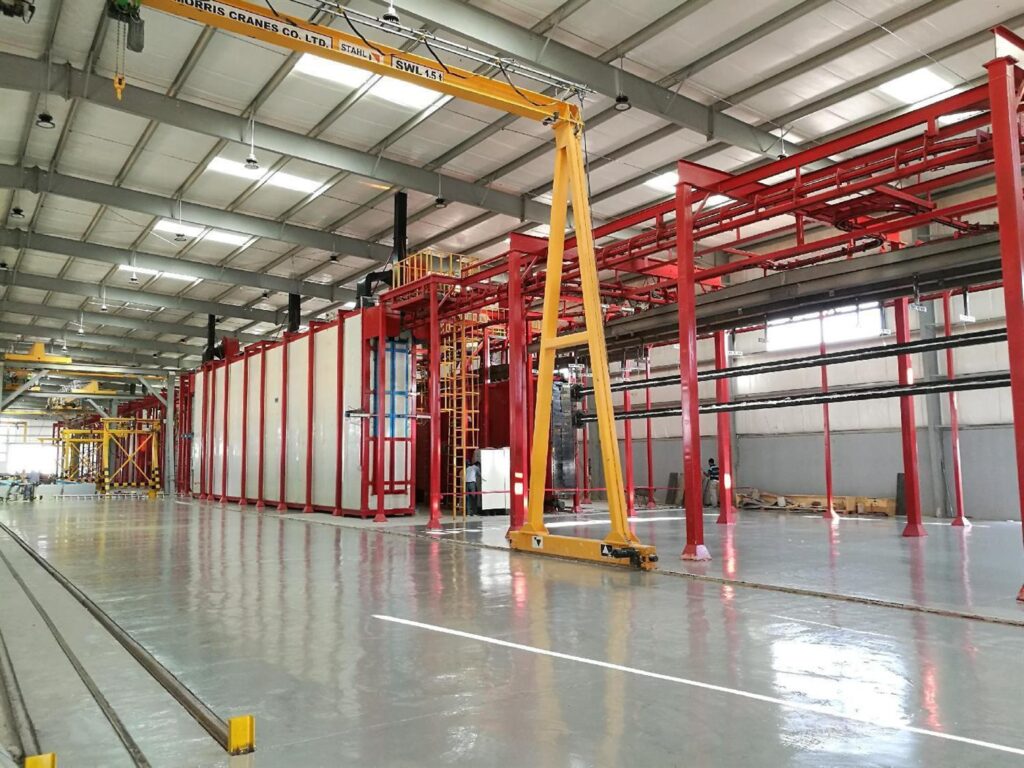
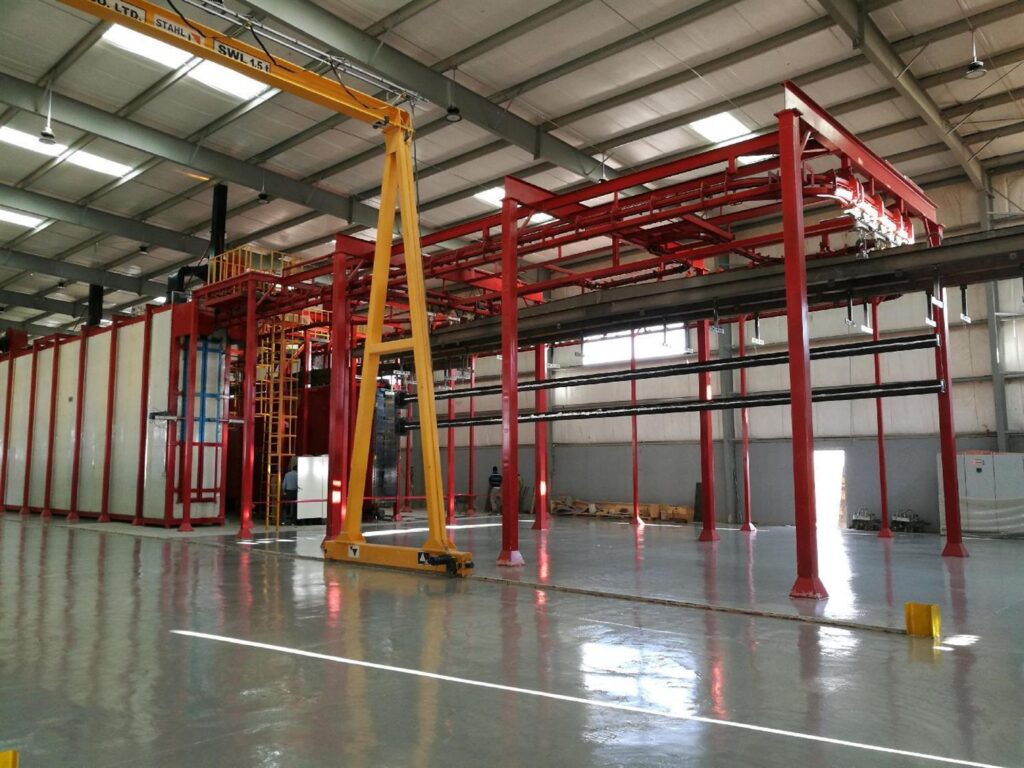
A complete powder coating line for a street lighting pole manufacturer in Riyadh. Poles are coated vertically, in lengths that would not fit any standard line, in a climate where summer air temperature and dust are both working against the finish. The line was built as numbered modules in China, shipped, and commissioned on site.
What the project had to solve
- Length. A street light pole is one piece, and it is coated as one piece. Pretreatment, booth and oven all have to accept the full pole standing upright, which drives the height of every chamber and the height of the conveyor.
- A galvanised surface. Most poles arrive hot-dip galvanised. Powder over galvanising is not the same job as powder over bare steel: the pretreatment decision, the zinc surface and the outgassing behaviour of a welded pole all affect adhesion, and this had to be settled before the line was ordered.
- Dust and heat. Riyadh runs above 45 °C in summer with fine airborne dust. Dust in the booth is a speck in the film; heat affects both the powder storage and the working conditions of the spray team.
- Handling. A finished pole is heavy and awkward. Loading, transfer and unloading are crane work, and the line has to be laid out around the crane envelope rather than around the conveyor.
- Shipping and site assembly. The whole line had to travel in containers and be assembled by a small team on site, with no fabrication capacity nearby.
How the line is built
The conveyor is a power & free system, rail-mounted, with carriers that can be stopped and accumulated independent of the chain. For poles this is the difference between a usable line and a theoretical one: a tall pole needs time at the booth for a full vertical pass, and a heavy pole needs its own time in the cure zone. With a plain overhead chain, every one of those stops stops the whole line.
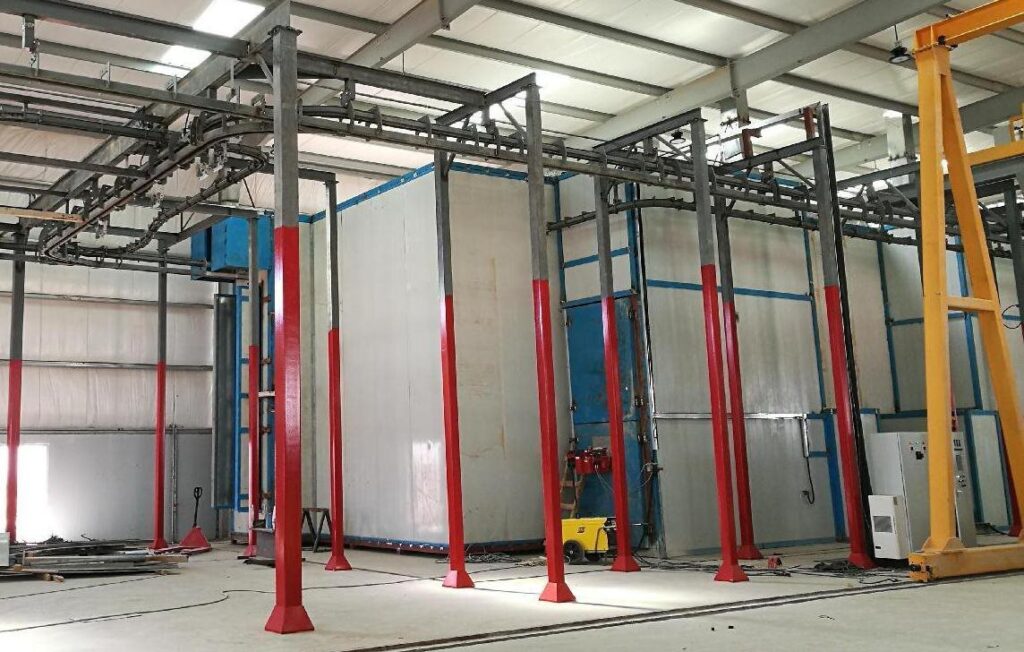
The frame is red-painted structural steel, fabricated in bolt-together modules, each numbered against a site drawing, so assembly on site is a sequence of lifts. Overhead cranes handle the poles at load and unload; the conveyor carries them through the process.
Pretreatment is a multi-stage spray system with SUS 304 inner tank walls and a galvanised, powder-coated outer skin, joined with a labyrinth profile welded on both sides so stages cannot leak into each other. Solution returns through a three-sided sloped bottom, nozzles are offset ring by ring to reach a round surface without shadow bands, and a 304 stainless vertical pump moves the chemistry. For a galvanised pole, the stage sequence and the final pure-water rinse are what decide whether the coating survives a salt-spray test.
Drying and curing ovens are bridge-type chambers, tall enough for a vertical pole, with 50 mm rock wool laid in staggered seams, a static air layer and a folded outer skin. Air is supplied from the bottom and returned at the top with adjustable ducts per zone, which is how a 10-metre part avoids being over-cured at the bottom and under-cured at the top. Measured cross-section stays within ±5 °C; the outer skin stays within about 8 °C of ambient, which matters when the ambient is already 45 °C.
Control is a Siemens / Schneider panel with touch screen HMI, one digital temperature controller per zone, VFDs on conveyor and fans and an MES interface reserved. Gas detection is interlocked with the burner. Panels are installed in shaded, ventilated positions and rated for the site’s ambient conditions.
Acceptance and handover
Acceptance was split in two. In China, the line was assembled and run at our production base: conveyor trial, oven profile, burner test and a coating trial on client-supplied pole sections – including a welded joint and a galvanised section, because those are where adhesion fails first. On site in Riyadh, our engineers supervised assembly and then ran commissioning: nozzle pressure per stage, bath concentration and temperature, oven profiles at three heights, and a production trial on real poles. Handover came after that, not before.
The takeaway for a buyer
If you coat long, single-piece parts – poles, beams, masts – ask three questions before you compare prices: how tall the chambers really are with the carrier height included, whether the conveyor can hold a part still at the booth, and how the oven is balanced along the length of the part rather than across its width. Those three answers decide whether the line coats a pole properly or coats it twice and reworks it.
Coating poles, masts or long fabrications? Send us the maximum length, the section profile and the required output per shift, and we will size the chamber heights and the carrier spacing around it.
See the full solution page: powder coating line for street lighting poles.
Customer name withheld at the request of the client. Photographs are from the installed line in Riyadh.