Powder coating line for electrical cabinets and vehicle electrical parts
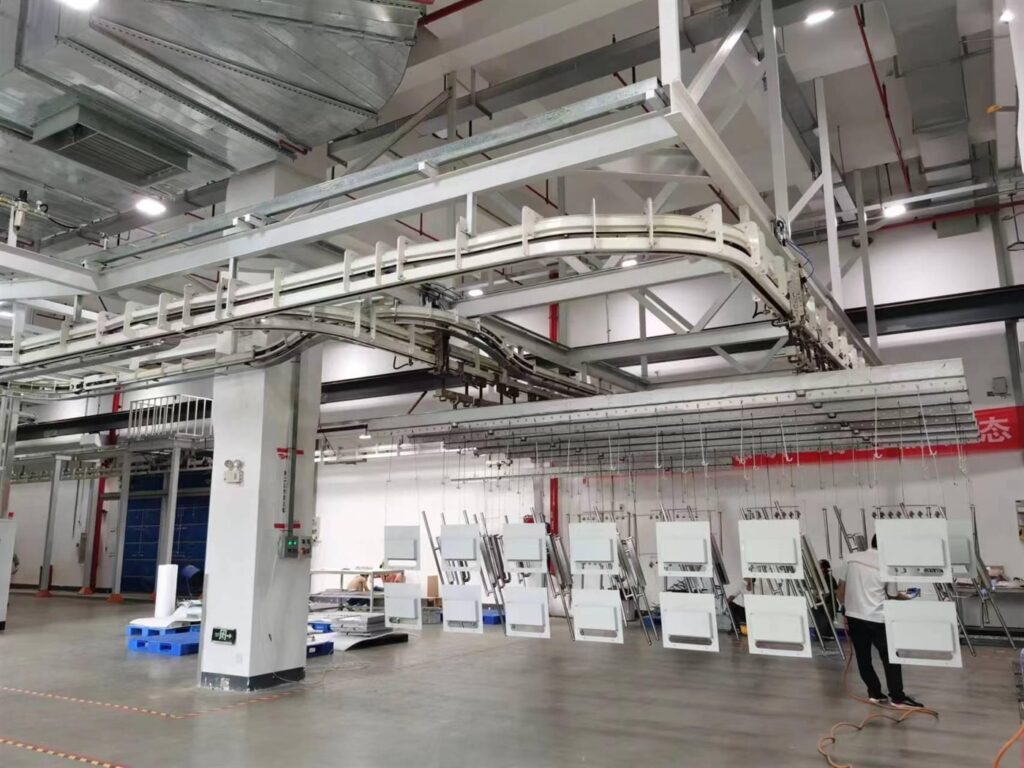
A power & free powder coating line for a plant in Guangdong that coats electrical cabinets, control boxes and vehicle electrical assemblies. The parts are flat panels and box bodies in mixed sizes, and almost every batch is a different colour.
What the project had to solve
- Colour changes all day. Batches of 20 to 200 pieces in different RAL colours mean the booth has to be cleaned between colours without stopping the conveyor.
- Flat panels show every defect. A cabinet door is a mirror: orange peel, a dry-spray patch or a shade difference between two doors of the same batch is immediately visible to the end customer.
- Mixed geometry on one line. Panels, boxes and small brackets hang on the same conveyor, and the spray stations must reach both a flat face and the inside corners of a box.
- Assembly follows coating. Parts go straight from the line to the assembly area, so the line has to deliver a complete, fully cured batch rather than partial loads.
How the line is built
The plant chose a power & free conveyor for one practical reason: it lets them accumulate. Carriers can be queued on the free line in front of the booth while the spray team finishes the previous colour, and released in a controlled stream afterwards. Load and unload happen at floor level next to the assembly area, and the conveyor does the vertical transport in between, which keeps the walking distance for operators short.
Hangers are designed per part family: a double-sided hanger for cabinet doors, a box hanger that exposes the inside of the enclosure, and small brackets grouped on a multi-position hanger so a batch of 50 does not need 50 carriers.
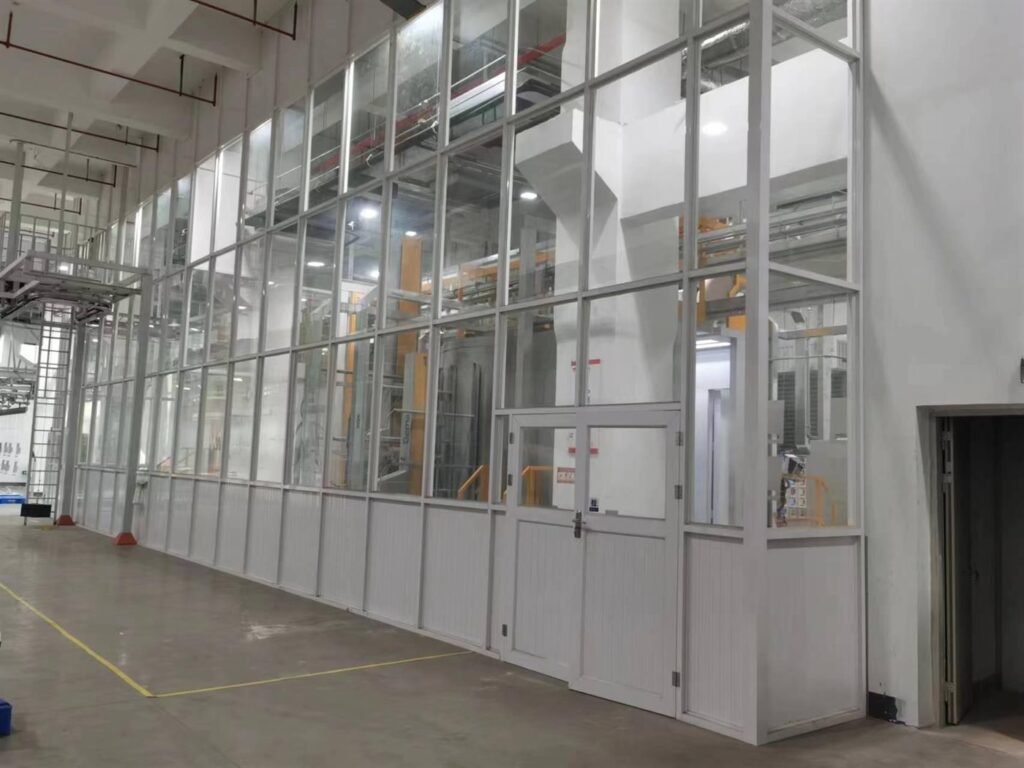
The booth area is enclosed with tempered glass partitions, separating the spray zone from the rest of the hall. That keeps airborne dust out of the coating, which matters more for a flat panel than for a casting.
Drying and curing are separate ovens. The water drying oven holds the parts at 120–160 °C for 10–15 minutes, enough to drive off moisture from the pretreatment without baking it in. The curing oven holds 180–220 °C for 15–20 minutes, with at least 10 minutes at a stable temperature, so the powder flows out completely and the film reaches full mechanical properties.
Both ovens use the same bridge-type chamber construction: a steel frame under the chamber, hand-laid staggered insulation panels with 50 mm rock wool and a static air layer, and a bottom-supply, top-return air path with adjustable ducts. Surface temperature of the oven skin stays within about 8 °C of ambient, which keeps the working area comfortable and cuts gas consumption.
The electrical system uses Siemens and Schneider components, with a touch screen HMI and a digital temperature controller per zone. Gas detection and alarm are interlocked with the burner, and an MES interface terminal is reserved for later connection to the plant’s production system.
Acceptance and handover
Acceptance covered a three-point temperature profile in each oven, coating thickness on flat and corner areas, an adhesion cross-cut test, and a colour comparison against a master panel under daylight. The plant also ran a full shift at production speed before sign-off, which is the only reliable way to find a carrier that jams at a curve.
The takeaway for a buyer
Electrical cabinets are one of the hardest part families for powder coating: flat surfaces, tight colour tolerance and frequent changeovers. If a supplier only quotes you a conveyor speed and an oven temperature, ask instead how the line accumulates before the booth, how the hangers expose box interiors, and how the booth is cleaned between colours. Those three answers decide whether the line runs at the rated output or at half of it.
Coating cabinets, panels or enclosures? Tell us the part list, the colours per shift and the required output, and we will size the conveyor and the ovens around it.
Customer name withheld at the request of the client. Photographs are from the installed line.