Conveyor

PRODUCT LINE

Overhead Chain and Power-and-Free Conveyors

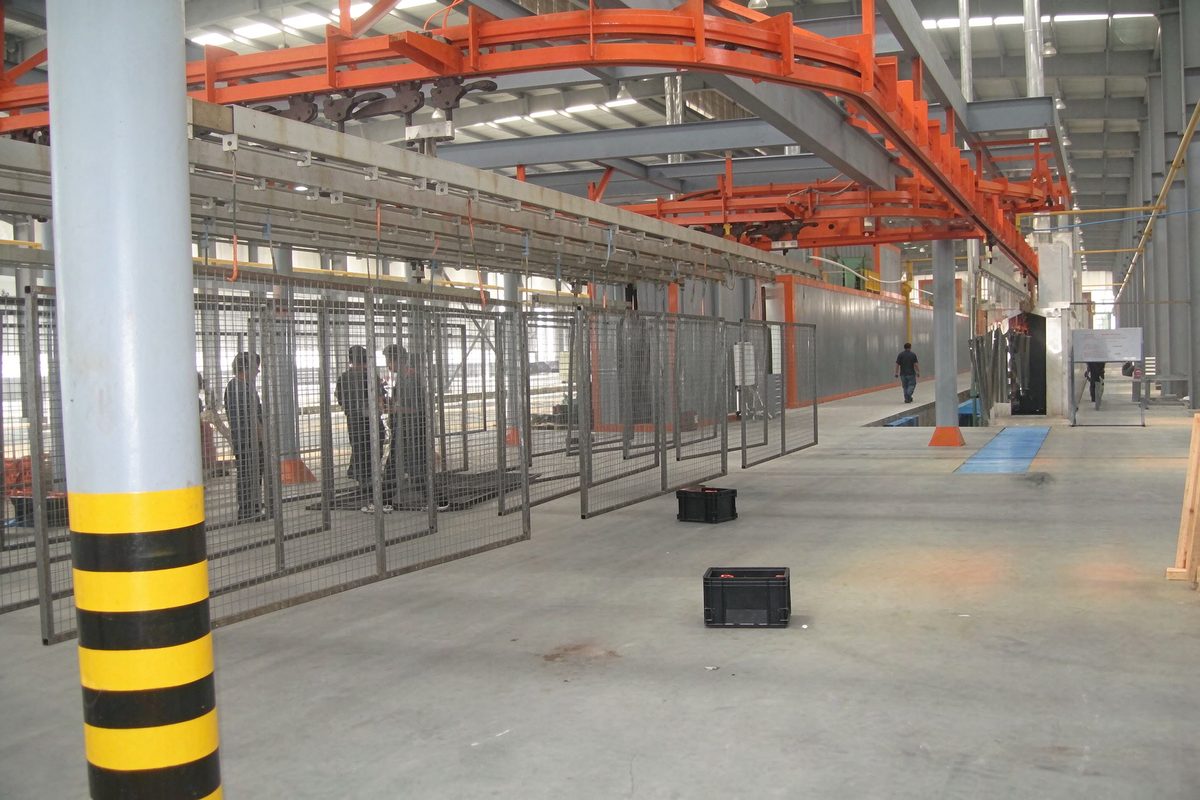
The conveyor ties every station together and sets the takt time of the whole line. We supply overhead chain, power-and-free and floor conveyors, sized to your hanger load, oven temperature and chemical environment.

Get a quotation

A simple overhead chain runs continuously at one speed. It is cheap, robust, and right for single-product, high-volume work.

A power-and-free conveyor lets carriers stop at stations independently – essential when pretreatment dips need dwell time while the oven runs continuously, or when you want buffers to absorb a breakdown at one station.

Chain, hangers and lubricators are selected for the environment: stainless or plated parts inside pretreatment and ovens, galvanised chain outside. Variable-frequency drive gives 0.5-6 m/min adjustment.
Conveyor

What is included

  • Overhead chain and power-and-free types
  • VFD speed control, 0.5 – 6 m/min
  • Hanger load typically 50 – 500 kg
  • Stainless or plated parts for wet and hot zones
  • Automatic lubrication and chain take-up
  • Buffers between stations on power-and-free

Typical specifications

ItemTypical specification
Typeoverhead chain / power-and-free / floor
Speed0.5 – 6 m/min, VFD
Hanger load50 – 500 kg, custom
Chaingalvanised or stainless with lubricator

Not sure which configuration fits your parts?

Send us your workpiece size, coating type and required output per shift. We reply with a line proposal and a budget range within one working day.

Request a quotationChat on WhatsApp

Overhead or power-and-free — pick by part flow

The conveyor is the backbone of a coating line: it sets the takt time, carries the hangers through every station, and determines whether you can stop a part in front of a booth.

  • Overhead chain conveyor — continuous, simple, lowest cost; parts move at constant speed through all stations
  • Power-and-free conveyor — each hanger can stop, accumulate and change speed; essential when parts must dwell in a booth or oven
  • Enclosed track — cleaner, keeps lubricant off the parts, common in food-adjacent and high-finish plants

Speed is normally variable from 0.5 to 6 m/min, with hanger pitch set by part size. Chain load, drive power and the number of drives are calculated from your heaviest hanger, not from an assumed average.

What we need to design the conveyor

  1. Heaviest hanger load and how many hangers on the line at once
  2. Part envelope, especially height above the hanger
  3. Which stations need the part to stop (booth, oven, loading)
  4. Total line length and the hall layout, including any turn
  5. Whether the line will be extended later

Frequently asked questions

Can we add stations to the line after it is running?

Yes, if we know at the design stage. Extra drive units, turn sections and spare track are added to the original layout so that a second booth or a longer oven can be inserted without replacing the whole conveyor.

How is the conveyor lubricated and maintained?

Enclosed-track conveyors use sealed bearings and need little lubrication; open chain conveyors need periodic oiling at the drive and turns. We supply a maintenance schedule with the drawings, and spare chain links with the shipment.

What happens if the conveyor stops?

The line has an emergency stop that also shuts the guns and holds the oven at temperature. Parts inside the oven can be manually advanced with the hand-wheel or jog function to avoid over-curing.

Buying guides for this equipment

Before you sign, three questions decide the outcome: what the equipment costs, how to size it for your parts, and what the contract should guarantee. These guides answer them with the numbers we use.

Conveyor: the part that sets your real output

Most line quotations are compared on oven size and gun count. In practice the conveyor decides whether the line runs at its rated output or at half of it, because the conveyor is what allows – or forbids – buffering, colour changes and mixed loads.

1. Power & free (accumulating) conveyor

  • Independent stop and accumulate. The powered chain drives the carriers, but each carrier can be stopped and released on the free line. Carriers queue in front of the booth while a colour change is finished, and queue in front of the oven while a heavy part finishes its cure.
  • Route selection. Switches on the free line let a carrier take one of two paths – for example past a second booth, or back to load – without stopping the main chain. That is how a mixed-model plant runs two products on one line.
  • Floor-level load and unload. Loading and unloading happen at working height next to the assembly area, and the conveyor does the vertical transport. Operators walk short distances, and heavy parts are lifted once, onto a carrier, instead of twice.
  • Space saving. Because carriers accumulate vertically, a power & free line fits into a hall where a plain overhead chain would need a straight run the length of the building.

2. Standard overhead chain

For a single product family at a steady output, a plain overhead chain is the cheaper and perfectly adequate answer. It cannot accumulate: every carrier moves whenever the chain moves, so a stop at the booth stops the whole line. We quote it when the part mix is stable and the batch sizes are large.

3. Inverted square-track chain

For parts that must be coated from above – or where a square, rigid track suits a long, straight layout – an inverted square-track (方轨) chain carries the hanger below the track. It is rigid, simple to extend, and often used for plastic housings and light components.

4. What we need to size it

Part weight and shape, hanger centres, the number of carriers needed at the booth and in the oven at the same time, the dwell time in each zone, and the hall layout including the crane envelope. From those numbers the chain speed, the free-line length and the number of carriers follow; the chain is not chosen first and the layout fitted around it afterwards.

Related: an export project built on a power & free line and a high-mix plant where accumulation was the deciding factor.

Send your line layout

BestCoatingLine

Powder coating lines, liquid painting lines and turnkey coating solutions. Designed, built and test-run at our production base in Zhongshan, Guangdong, China.

WhatsApp / WeChat: +86 156 0291 6761

[email protected]

Registered office

Sales departmentRoom D327, No. 42 Caiyun Road,
Longcheng Street, Longgang District,
Shenzhen, Guangdong, China

CompanyBEST MACHINES & EQUIPMENTS CO., LTD.

Production base

Project officeNo. 6-1, Dongsheng Road, Dongsheng Village,
Minzhong Town, Zhongshan,
Guangdong, China

Assembly base

Machining & assemblyChashan, Dongguan,
Guangdong, China

Working hoursMon-Sat, 08:30-18:00 (GMT+8)

© 2016-2026 BEST MACHINES & EQUIPMENTS CO., LTD. All rights reserved. Coating line solutions since 2016
Scroll to Top